
The Bogus Indus Valley ‘Horse Seal’
Go to Steve Farmer downloads for more recent materials.
This webpage contains a description of how Michael Witzel and I originally unmasked N.S. Rajaram’s famous forged “horse seal.” It summarizes the evidence known as of 8 September 2000. Parts of the story that emerged after that date are discussed in the series of articles, beginning with “Horseplay in Harappa,” published in October and November 2000 in Frontline, the Indian news magazine. For those articles and on Indus inscriptions in general, which we have since shown weren’t part of a true “writing system,” as claimed since the 1870s, go to Steve Farmer downloads (scroll down to get to links to the original Horseplay articles, in section 4.1-4.3). I have left this original web page up, with minor text editing, for historical reasons.
The “horse seal” first showed up in N. Jha and N. S. Rajaram, The Deciphered Indus Script (Aditya Prakashan, New Delhi, 2000). Rajaram sent me a copy of the book to me in California that summer. I made a copy of it and sent the original to Michael Witzel, on the East Coast. Rajaram takes responsibility for writing the book, but credits Jha with inventing the decipherment method. Publicity for the work hails the unknown Jha, described by Rajaram as “one of the world’s foremost Vedic scholars and paleographers,” with “solving what is widely regarded as the most significant technical problem in historical research in our time.” That claim, as well as the decipherments, was thoroughly debunked in by the two of us in July 2000 on the Indology List (for the full story, see the List Archives).
Readers not familiar with Harappan or Indus Valley Civilization (IVC) should note that finds in the IVC of horses (which turn up frequently in the Rajaram/Jha “decipherments”) would have revolutionary implications, since that discovery would close a “missing link” between the horseless IVC and the intensely horse-dependent culture of the Rigveda — the oldest religious text in India. Showing that the culture of the Rigveda was native to India, and not an import from the Northwest, is a prime goal of “out-of-India theory” proponents like Rajaram, most of whom are closely tied to the rightwing Hindu nationalist (Hindutva) movement.
(For a taste of Rajaram’s politics, and a wildly inflated autobiographical portrait, go to his ironically named Sword of Truth website.
The political motives behind Rajaram’s book have to be kept in mind when reading the story of the “horse seal” told below. The fact that Rajaram’s works are not taken seriously by academic researchers explains why something as transparently false as the “horse seal” might slip through the cracks without being critically examined. Despite their scholarly pretenses, Rajaram’s books are aimed primarily at Indian laymen in South Asia and in the U.S. In both groups, Rajaram has a significant following. Few of Rajaram’s readers would have access to the research tools needed to doublecheck his badly referenced studies.
The story begins with two pictures in the book by Rajaram and Jha. It is important to note that the quality of the images shown here is not significantly worse than what we find in the book:
Rajaram elaborates on his claims for the seal on p. 162. His rhetorical attack is typical of his style:
The ‘horse seal’ goes to show that the oft repeated claim of “No horse at Harappa” is entirely baseless. Horse bones have been found at all levels at Harappan sites. Also, as we have already seen, the word ‘asva’ is a commonly occuring [sic] word on the seals. The supposed ‘horselessness’ of the Harappans is a dogma that has been exploded by evidence. But like its cousin the Aryan invasion, it persists for reasons having little to do with evidence or scholarship. A well known ‘Dravidianist’ tried to argue with Rajaram that the animal on the seal in question (Mackay 453) is not a horse but a unicorn bull. A comparison of the two creatures, especially in genital area shows this to be fallacious.
It should be noted that the claim that “Horse bones have been found at all levels at Harappan sites” is disputed by specialists on the issue, including Harvard University archaeologist Richard Meadow. The “prominent ‘Dravidianist'” referred to in this passage is I. Mahadevan, author of the most widely used concordance of Indus inscriptions (1977). Mahadevan’s views on Harappan horses are contained in part of an interview archived at the www.harappa.com website.
When I first saw Rajaram’s “horse seal,” in the summer of 2000, I was struck by the fact that Figure 7.1.a in his book (which looks like a deer to most people) was much more distorted than any other photo I had ever seen of an Indus seal. Rajaram went to lengths to produce an “Artist’s reproduction” of the “horse seal,” so you’d expect a clear reproduction of the original.
In a statement sent to me, Witzel, and a number of his own supporters (including K. Elst) on 30 July 2000, Rajaram let it slip that his image was a “computer enhancement” produced “to facilitate our reading.” It is important to note that this is not mentioned in his book. This confirmed the suggestion that I made previously on the Indology List that the image was a computer distortion.
After studying Rajaram’s photo, I spent many hours tracking down the three works by Mackay (in six volumes of old archaeological studies) that Rajaram mentions in his bibliography. He does not say which of these contains Mackay 453. That made me more suspicious. Given the importance of Rajaram’s claims, you would expect his sources to be fully referenced, so other researchers could quickly check the evidence.
Mackay 453 eventually turned up on a tiny photo on Plate XCV of Vol. II of Further Excavations of Mohenjo-Daro (New Delhi, 1937-1938). The original looks very different from the “computer enhancement” of the seal. Since Rajaram boasts that he was involved for years in computer imaging work for Lockheed and NASA, and involoved further in work for the U.S. Department of Defense, the distortions in his reproduction of the “horse seal” can’t be dismissed as an amateur’s error.
The picture in Mackay is small and fuzzy, but it is a lot clearer than what we find in Rajaram’s book. When you look at the picture itself, it is obvious that the seal is broken. Indeed, the whole of the front torso of the animal, as well as the neck and head, is broken off. What appears to many people who have seen Rajaram’s “computer enhancement” to be the “neck” and “head” of a deer disappears when you look at the original.
Below is a scanned image of Mackay 453 as it appears in the original text. For reasons that will become clear in a minute, it is important to note that Mackay 453 is not the photo of a seal but a modern clay impression of a seal (field number 6664) recovered from Mohenjo-daro during the 1927-31 excavations:
While I was searching on the West coast for Mackay 453, Michael Witzel at Harvard found a photograph of the original seal (identified by its field number, 6664) that was used to create the impression seen in Mackay 453. The original seal is portrayed in a crisp photo in Asko Parpola et al., eds., A Corpus of Indus Seals and Inscriptions, Vol. II: Collections in Pakistan (Helsinki 1991, p. 63).
Parpola M-772-A is the only recent photo of the original seal that (based on Mackay’s old impression) Rajaram claims to be a “horse seal.” According to an email from Parpola to Witzel, the seal (used seven decades ago to create the seal impression in Mackay 453) was photographed in Pakistan by Parpola’s staff photographer, Jyrki Lyytikkä, when Parpola was compiling his two-volume collection.
Parpola writes that “naturally the animals are just ‘unicorn’ bulls, as on so many other seals.” Thus Mahadevan and Parpola agree that the “horse seal” (as is obvious to anyone who studies it) is simply a broken “unicorn” seal.
Ample pictorial evidence that confirms this is presented below. On the left is a photo of the original seal, reproduced in Parpola’s standard two-volume corpus of seals (which was not consulted by Rajaram). On the right is the seven-decade-old photo of the seal impression, published as Mackay 453, that was further distorted in Rajaram’s “computer enhancement” to create the “horse seal.”
I’ve flipped the image of the original seal (M-772 A) horizontally so the inscriptions on the seal and its impression in Mackay 453 can be easily compared. The images have not been “computer enhanced” in any way:
Note the bull-like rear end of the animal on the original seal, which shows up clearly in Jyrki Lyytikkä’s photograph. It is more than peculiar, given the magnitude of his claims, that Rajaram didn’t check his evidence against Parpola’s volumes, which are indispensable for anyone working with Indus inscriptions.
Note too that the tail of the animal on the seal is the typical “rope” tail associated with unicorn bull seals at Mohenjo-daro. It is not the “bushy tail” of a horse that Rajaram imagines. In a recent statement sent to me by Rajaram, with copies forwarded to Witzel and a number of Rajaram’s supporters (like K. Elst), Rajaram claims:
…if you insist that the animal with a bushy tail is still a bull, you are entitled to your beliefs. If this is your attitude – refusing to see the evidence of not only the seal and the horse bones that have been known since 1935 – I see little point in continuing the dialog. Let us leave it that (27 July 2000).
Discussing the distorted image of Mackay 453 found in his book, Rajaram makes much in his study of supposed differences between unicorn bulls and this animal “in the genital area.” As is clear in the photo of the original seal, no genitals are seen there at all. The reason why is obvious: In unicorn bull seals, the genitals are normally found just about where the crack shows up on the seal!
The upshot of this is that if you want to claim that you have a “horse seal,” just find a unicorn bull (like the one found in M-772 A or its old impression, Mackay 453) where the front of the bull is broken off around the genitals.
A seal impression of M-772 A (designated as M-772 a in Parpola), at first sight appears to have genitals, as reported in an earlier version of this webpage. But Parpola (again in a note to M. Witzel) confirms that the “genitals” are an artefact of damage in the (modern) seal impression photographed by Jyrki Lyytikkä.
Below is a scanned photo of the damaged impression, where the illusion of “genitals” is created by nicks in the clay:
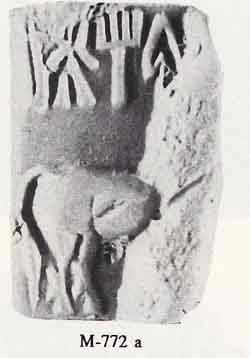
Due to the conveniently located crack in the seal, no genitals show up in M-772 A (the original seal) or Mackay 453 or M-772 a (the modern impressions of that seal). But several other seals throw light on the genital issue. One is Parpola M-1034 A and its impression, M-1034 a.
Parpola M-1034 A has much in common with Rajaram’s “horse seal,” including the first two characters of the inscription. It is also broken, but in a different place, wiping out the last part of the inscription but leaving the genitals intact. On this seal we find the distinctive “unicorn” genitals, identified by the long “tuft” hanging straight down. The genitals are about where we’d expect them on M-722 A or its impression, Mackay 453, if those objects weren’t cracked.
The implication again is that M-772 A/Mackay 453 is simply one of dozens of broken Mohenjo-daro unicorn seals — a point emphasized by I. Mahadevan and Asko Parpola.
Below, we show a modern clay impression of M-1034 (which in this case is clearer than the photo of the seal itself). This image was scanned at a lower resolution than the images shown above, so we’ve left the reproduction small in order not to distort the picture:
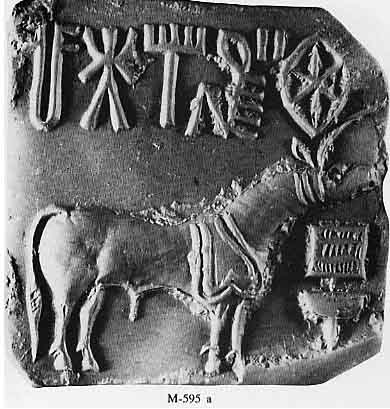
Let’s look now at a complete unicorn bull in Parpola M-595 a. Even more than previous examples we’ve seen, the backend of this animal could easily pass (to the wishful eye) for a horse’s rear. It would, in fact, be possible to create a convincing “horse seal” out of this unicorn simply by breaking the seal (à la M-772 A/Mackay 453) where the genitals are.
Place the edge of your index finger at about 1 o’clock over the horse, just barely covering the genitals, and admire your new-found “horse seal”! Indeed, the rear end of the animal looks a lot more like a horse than the original of Rajaram’s “horse seal” — M-772 A/Mackay 453!
Let’s go back one last time to compare Mackay 453 with the grossly distorted image (aka Rarjaram’s “computer enhancement”) reproduced in Rajaram’s book:
What is the alien object on the lower righthand side — where nothing is found in the original photo? You might think, at first, that it was distortion caused by Rajaram’s “computer enhancement.” However, repeated tries to replicate the object using contrast tools, edge enhancers, and a number of PhotoShop filters, fail to produce anything like it. Moreover, the object has an eerily familiar look about it to anyone who has looked at a lot of Harappan seals.
On the Indology List on 3 August 2000, the Russian Indologist Yaroslav Vassilkov made the following suggestion:
… there is a small detail in the picture of the “Horse Seal” (“Mackay 453”) in Rajaram’s book which seems to have escaped the attention of the Indologists as yet. However, this small detail leaves us no doubt that Rajaram did not limit himself with adjusting the contrast on Mackay 453. He went much farther than that. In the Figure 7.1a (“The Horse Seal”) of Rajaram’s book one can see in the right lower corner, just in front of the “forelegs” of the animal, the silhouette of a well-known IVC artefact or symbol. It is the so called “feeding trough”. On many seals we can see it standing on the ground before an animal, at its feet. This particular form of the “feeding trough” resembles in its silhouette an old-fashioned telephone set with conical base and the receiver lying across its top. But this specific form appears in front of some animals exclusively, as it seems to me, or almost exclusively on the copper tablets, not on the seals….So, as we see, Mr.Rajaram did not stop at playing with shades and contrasts. He also put in the lower right corner of the picture the “telephone-shaped” trough which he had taken most probably from some copper tablet, or maybe from another seal….
It would probably be impossible to prove that Professor Vassilkov’s hypothesis is correct. If for whatever reason (an “insider’s joke,” or an early creative reconstruction?) someone copied-and-pasted a “telephone feeding trough” into Mackay 453, we could hardly expect him or her to come forward later to admit it. Moreover, after the seal underwent “computer enhancement” — introducing noise into the image and obscuring the break in the seal — the object would have been distorted almost beyond recognition.[Note added after this page was written: the origins of the apparent “feeding trough” was eventually discovered and is discussed in the November 2000 Frontline article by me and Witzel entitled “New Evidence on the ‘Piltdown Horse Hoax’.” See file 4.2 at safarmer.com/downloads.]
But, supporting Vassilkov’s hypothesis, there is no question that what we see here does look a bit like the “telephone feeding troughs” found in pictures of copper plates in Marshall, Mackay, Mahadevan, Parpola, and other sources. Moreover, the object is located exactly where we’d expect to find a feeding trough in a Harappan image.
Below, we show a few of these feeding troughs — scanned in from drawings of copper plates in Marshall (1931):
Rajaram’s image of the “horse seal” is too distorted to make any final judgment about the identity of this object. Nonetheless, the object is clearly not found in the original — and that alone demands an explanation. Rajaram has been asked about the object — and about the “computer enhancement” in general — but so far has refused to comment.
I’ll end with a statement that Rajaram recently sent to me, Witzel, Koenraad Elst, and a number of others:
The problem seems to be that many Indologists are still trying to work within the framework of nineteenth century formulation. When new evidence came to light, especially in the past 60 years, instead of reexamining their formulations, they are trying to select, discard and manipulate dat[a] to preserve their beliefs. This bespeaks a t[h]eological rather than a scientific mindset. A debate with such people is pointless (21 July 2000).
In light of Rajaram’s condemnation of Indologists who “select, discard, and manipulate dat[a] to preserve their beliefs,” it is ironic that he continues to defend his “horse seal” — long after the evidence summarized above has been made public. Indeed, Rajaram has threatened both legal and extralegal action against those he claims have launched a vicious witchhunt against him.
Feb 2023 format changes from web server migration.